Imagine this: Your marketing team delivers a flawless product launch. The messaging is sharp, the materials are polished, the digital channels are humming, and the sales team feels supported. By all traditional marketing metrics, it's a success. Yet, at the following quarterly business review, the conversation quickly moves beyond launch execution to deeper strategic questions: How is this launch really impacting our market share trajectory against Competitor X? What is real-world data telling us about adoption hurdles in specific hospital systems? How does this product's performance change our portfolio investment priorities for next year? And how are we – Marketing included – shaping that bigger picture?
If you sometimes feel a disconnect between excellent marketing execution and deep strategic business contribution, you're not alone. In the complex, high-stakes arena of Medical Technology, marketers have a powerful opportunity - and an increasing necessity - to transcend traditional functional boundaries and operate as true business leaders.
This post is a conversation for two critical groups:
Ambitious MedTech Marketers: You aspire to do more than manage campaigns. You want to shape strategy, influence outcomes, and drive growth. This is about understanding the path to becoming a strategic leader within your organization.
Forward-Thinking MedTech Senior Leaders: You recognize that talent is your greatest asset. This is about how to intentionally cultivate business leadership within your marketing function, transforming it from a support service into a strategic powerhouse that drives competitive advantage.
I won't delve into the mechanics of building a marketing plan. Instead, I'll focus on the critical evolution required: the mindset shift, the skill development, and the organizational empowerment needed for MedTech marketers to step fully into roles as business architects and for leaders to champion this vital transformation.
The MedTech Imperative: Why Marketing Must Equal Business Leadership
The unique dynamics of the MedTech industry inherently demand a broader business perspective from marketers:
The Ecosystem Maze: Navigating the complex web of clinicians, hospital administrators, payers, regulators, engineers, and sales teams requires more than targeted messaging; it requires strategic stakeholder management and system-level thinking.
Data as the Default Language: Clinical evidence, health economic outcomes, and real-world data aren't just inputs for marketing; they are the strategic ground upon which markets are won or lost. Marketers must be fluent in interpreting and strategically leveraging this data. 1
Value Over Features: With increasing pressure from value-based healthcare initiatives that I’ve written about earlier, success hinges on demonstrating not just clinical efficacy but quantifiable economic value. This requires marketers to think like health economists and market access strategists, not just product promoters. 2
Long Horizons & High Stakes: Long development cycles, complex sales processes, and the profound impact on patient lives necessitate strategic foresight, risk management, and a deep understanding of the long-term business implications of decisions.
In this environment, marketing confined to purely promotional activities is insufficient. True value creation comes when marketers deeply understand the interplay of clinical need, technical feasibility, regulatory pathways, reimbursement realities, competitive strategy, and financial objectives. It comes when they act as integrators and strategic drivers – when they act as business leaders.
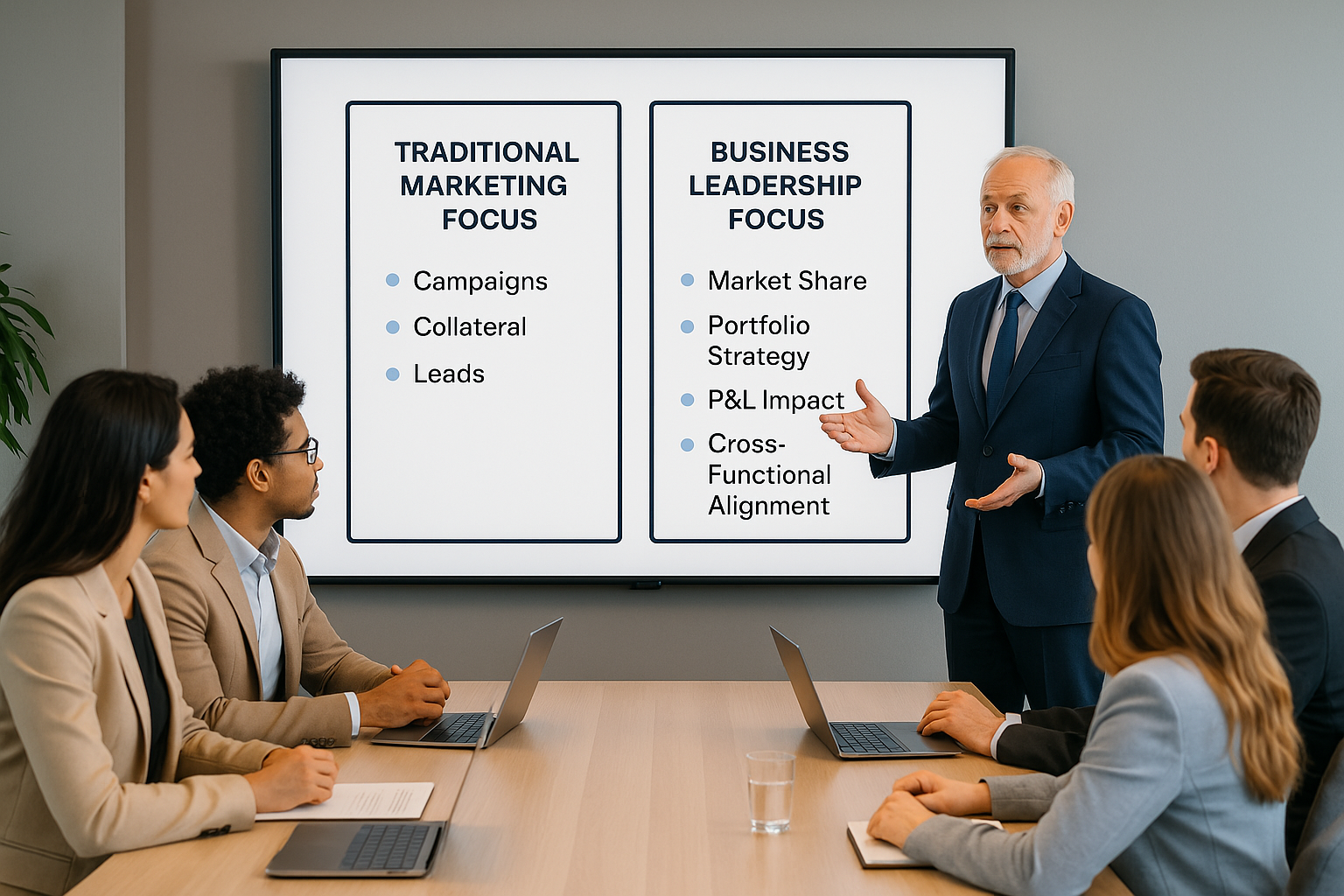
Defining the MedTech Marketing Leader: Beyond the Tactics
What distinguishes a MedTech marketer operating as a business leader? It’s less about specific tasks and more about mindset and competencies:
Strategic Perspective: They see beyond the next campaign to understand the broader market landscape, competitive dynamics, and long-term strategic goals. They connect marketing activities directly to objectives like market share gain (Earn Share) or category growth (Stimulate Demand).
Financial Acumen: They understand the P&L implications of marketing decisions. They can discuss pricing strategy, contribution margins, ROI expectations, and budget justifications in the language of finance. They see marketing spend as an investment, not just an expense.
Cross-Functional Fluency: They understand the priorities, constraints, and contributions of R&D, Clinical, Regulatory, Sales, Operations, and Finance. They build bridges and foster collaboration, acting as a central hub for commercial strategy.
Data-Driven Orientation: They move beyond reporting vanity metrics. They focus on KPIs that reflect true business impact (e.g., adoption rates, procedure volume, customer lifetime value, market share shifts) and use data to generate insights, test hypotheses, and adapt strategies.
Outcome Ownership: They take ownership of business outcomes (revenue, market share, profitability for their product line), not just marketing outputs (brochures, website visits).
Influence Without Authority: They excel at leading initiatives and aligning disparate teams towards a common goal, even without direct managerial control over all players. 3
This is a shift from being a specialist in marketing to being a general leader responsible for the commercial success of a product or portfolio, leveraging marketing expertise as a core component of that responsibility.
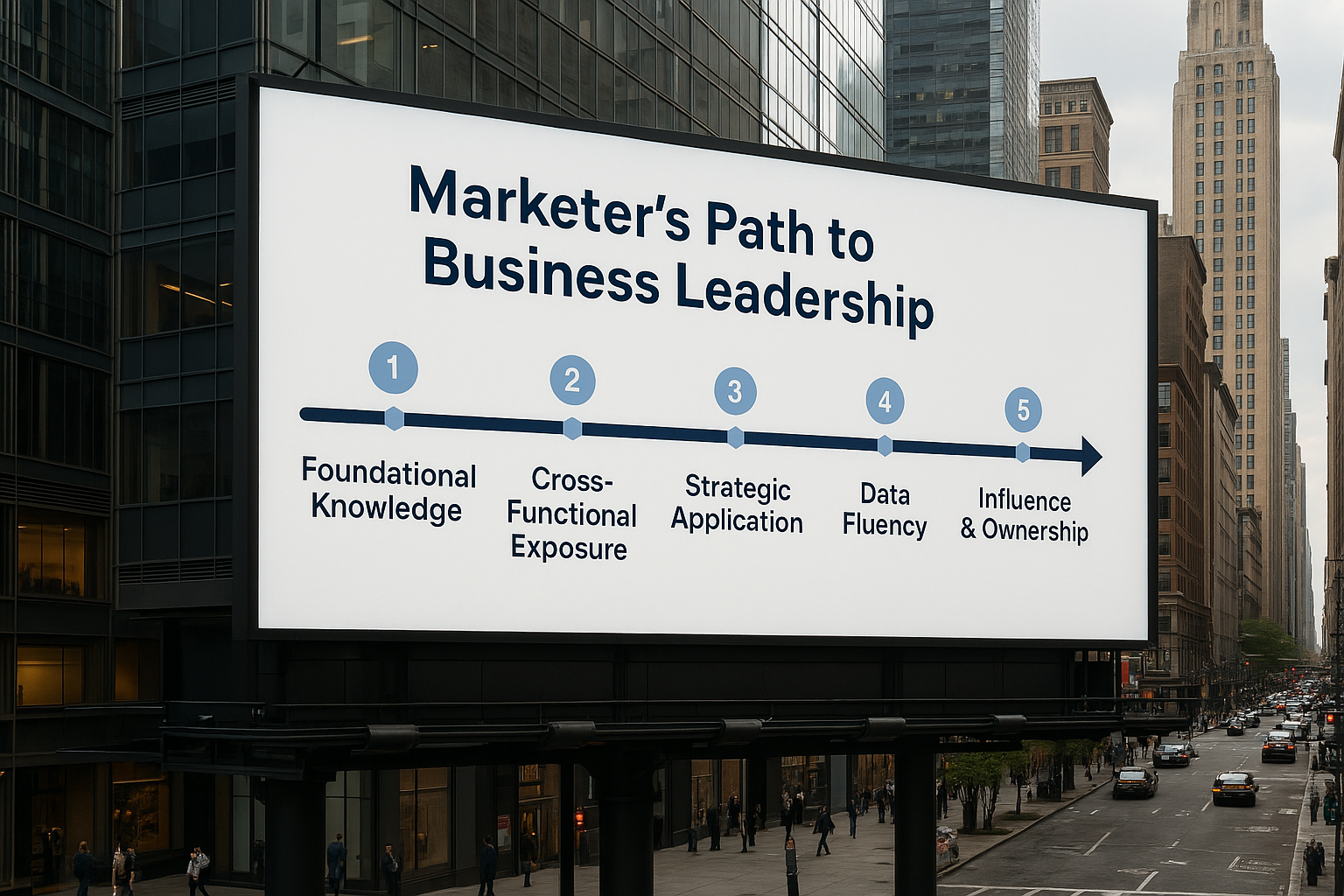
The Marketer's Journey: Actively Cultivating Business Leadership
If you're a marketer aspiring to this level, the journey requires intentional effort. You need to proactively build the mindset and skills required:
Seek Broader Business Knowledge:
Learn Finance Basics: Understand financial statements, key ratios, margin analysis, and budgeting processes. Many companies offer internal "Finance for Non-Finance Managers" courses, or numerous external options exist.
Understand the Value Chain: Spend time learning about R&D processes, clinical trial phases, regulatory submission requirements, manufacturing complexities, and the sales cycle from your colleagues in those departments.
Study the Market & Competition Deeply: Go beyond surface-level updates. Analyze competitors' strategies, financial performance, and pipeline. Understand reimbursement trends and healthcare policy shifts impacting your therapeutic area.
Build Cross-Functional Bridges:
Walk in Their Shoes: Actively seek opportunities to shadow colleagues in Sales, Medical Affairs, R&D, or Operations. Attend their team meetings (where appropriate) to understand their perspectives and challenges.
Be a Connector: Volunteer for cross-functional projects. Proactively share relevant market insights with other departments and solicit their input on marketing strategies.
Speak Their Language: Learn the key terminology and metrics used by other functions. Frame your proposals and updates in ways that resonate with their priorities.
Practice Strategic Thinking:
Ask "Why?": Constantly question the strategic rationale behind activities. Why this segment? Why this channel? How does this support the overarching business objective (Acquisition/Retention, Earn Share/Stimulate Demand)?
Use Strategic Frameworks: Apply models like SWOT or Porter's Five Forces (even informally) to analyze your market and competitive position. Think about resource allocation tradeoffs.
Think Long-Term: Consider the 3-5 year implications of today's decisions. How does this product fit into the future portfolio? What market trends might impact it?
Embrace Data for Insight, Not Just Reporting:
Focus on Outcome Metrics: Prioritize KPIs that directly reflect business impact over activity metrics.
Develop Analytical Skills: Learn basic data analysis and visualization techniques. Focus on identifying trends, correlations, and potential root causes.
Test and Learn: Frame marketing initiatives as experiments with clear hypotheses and measurable outcomes. Use pilot programs to validate approaches before scaling.
Cultivate Influence:
Build Trust: Be reliable, transparent, and demonstrate competence. Follow through on commitments.
Communicate Clearly & Persuasively: Hone your presentation skills. Tailor your communication style to different audiences (e.g., executive summary for leadership, detailed clinical data for physicians).
Seek Feedback: Ask colleagues in other functions how marketing can better support their efforts and be open to constructive criticism.
This journey is about broadening your aperture, developing new competencies, and fundamentally shifting how you view your role within the organization.
The Leader's Role: Actively Empowering Marketers as Business Leaders
Senior leaders have a profound influence on whether marketers remain tactical executors or evolve into strategic business partners. Passive hope isn't enough; active empowerment is required:
Invest Deliberately in Business Acumen:
Provide Targeted Training: Sponsor participation in courses on finance, strategy, health economics, or leadership relevant to the MedTech context.
Facilitate Cross-Functional Exposure: Create formal rotation programs or informal opportunities for marketers to spend time in Sales, R&D, Market Access, or other key areas.
Share the Bigger Picture: Regularly include marketing team members (not just leaders) in broader business strategy discussions, portfolio reviews, and financial updates. Context is critical.
Delegate Strategically, Not Just Tactically:
Assign Ownership of Business Problems: Instead of asking for "a new brochure," task marketers with "developing the strategy to increase adoption in community hospitals" or "analyzing the competitive threat from Product Y and recommending a response."
Expect Marketers to Make Pricing & Portfolio Decisions: Seek their input based on market understanding and competitive analysis. Let them contribute to, and understand the rationale behind, high-level strategic choices.
Give P&L Visibility/Responsibility: Where appropriate, give product managers or marketing leaders visibility into, or even accountability for, the financial performance of their products/portfolio.
Coach for Strategic Thinking:
Ask Strategic Questions: Go beyond campaign metrics. Ask: "What assumptions underpin this forecast?" "What are the risks to this plan?" "How does this align with our core competencies?" "What's the alternative?" "How will we measure true business impact?"
Challenge Tactical Defaults: Encourage marketers to justify why a specific tactic is the best strategic lever, rather than simply executing familiar plays.
Mentor on Influence & Collaboration: Coach them on navigating cross-functional dynamics, building consensus, and presenting compelling business cases.
Foster a Culture of Collaboration & Shared Ownership:
Break Down Silos: Structure meetings and projects to include relevant cross-functional players from the outset. Avoid reinforcing an "us vs. them" mentality between Marketing, Sales, R&D, etc. 4
Align Goals & Incentives: Where possible, ensure that marketing objectives and incentives are aligned with those of Sales and overall business unit performance, fostering shared accountability.
Publicly Recognize Strategic Contributions: Highlight instances where marketing thinking has demonstrably influenced business strategy or outcomes, shifting perceptions of the function's role.
Empowering marketers isn’t just about being “nice”; it’s a strategic investment in building a more commercially savvy, agile, and effective organization.
The Organizational Payoff: Why This Transformation Matters
When MedTech marketers operate as business leaders, the entire organization benefits:
More Robust Strategies: Marketing insights into customer needs, market dynamics, and competitive positioning are integrated earlier and more deeply into overall business strategy.
Improved Resource Allocation: Marketing investments are more clearly linked to strategic priorities and ROI expectations, leading to better decisions about where to place bets.
Faster, More Aligned Execution: Clearer strategic direction and stronger cross-functional collaboration orchestrated by marketing leaders reduce friction and accelerate time-to-market and adoption.
Enhanced Competitive Advantage: Organizations with commercially astute marketing leaders are better equipped to anticipate market shifts, differentiate their offerings based on true value, and outmaneuver competitors.
Stronger Talent Pipeline: Investing in marketers' growth creates a pool of future general managers with deep commercial understanding – crucial for succession planning.
Increased Job Satisfaction & Retention: Empowered marketers who see the direct impact of their work on the business are more engaged and likely to stay.
Conclusion: A Shared Responsibility, A Powerful Future
The evolution of the MedTech marketer into a business leader is not just a career progression pathway; it's a strategic imperative for companies navigating the complexities of modern healthcare. It requires a dual commitment: marketers must proactively broaden their skills and perspectives, and senior leaders must intentionally create an environment where that growth is expected, supported, and rewarded.
For marketers, embrace the challenge to think bigger, learn continuously, and step up to lead from where you are. For senior leaders, recognize the strategic potential within your marketing teams and invest in unlocking it. By working together, we can elevate the role of marketing and build more resilient, adaptive, and successful MedTech organizations poised to make a meaningful difference in patient care. The architect's pen is waiting.
Footnotes:
1
The critical role of data in MedTech value demonstration is consistently highlighted by industry consultancies and publications. For example, McKinsey articles often discuss the shift towards evidence-based commercial models. [Link relates generally to McKinsey insights on MedTech: https://www.mckinsey.com/industries/life-sciences/our-insights]
2
The impact of Value-Based Healthcare is a core theme in healthcare policy discussions and impacts MedTech strategy significantly. See resources from health policy journals or organizations like the National Academy of Medicine. [Example: https://nam.edu/programs/value-science-driven-health-care/]
3
Influencing without authority is a well-established leadership competency discussed in numerous business leadership books and articles. Eg. Allan R. Cohen & David L. Bradford's work remains relevant.
4
The detrimental effects of functional silos and the benefits of cross-functional collaboration are frequently discussed in organizational effectiveness literature and publications like Harvard Business Review. [Example general HBR search on collaboration: https://hbr.org/search?term=cross-functional%20collaboration]